You can’t see what’s in a supplement tub. You’re trusting a label printed by the same company that wants your money. That’s the whole game. And in an industry built on “trust me, bro,” most brands are counting on you not to ask the one question that matters:
Where’s the test?
Not the marketing. Not the influencer. Not the shiny label with a flag on it. The test — an independent, third-party lab result that proves what’s actually in the tub matches what’s printed on the side. If a brand can’t hand you that, you’re not buying a supplement. You’re buying a guess.
This is the case for third-party testing — what it is, why proprietary blends are a red flag instead of a feature, and how we test every batch of Battle Ready Creatine so you never have to take our word for it.
“If a company won’t show you the test, they’re not protecting a secret formula. They’re protecting a weak one.”
What does “third-party tested” actually mean?
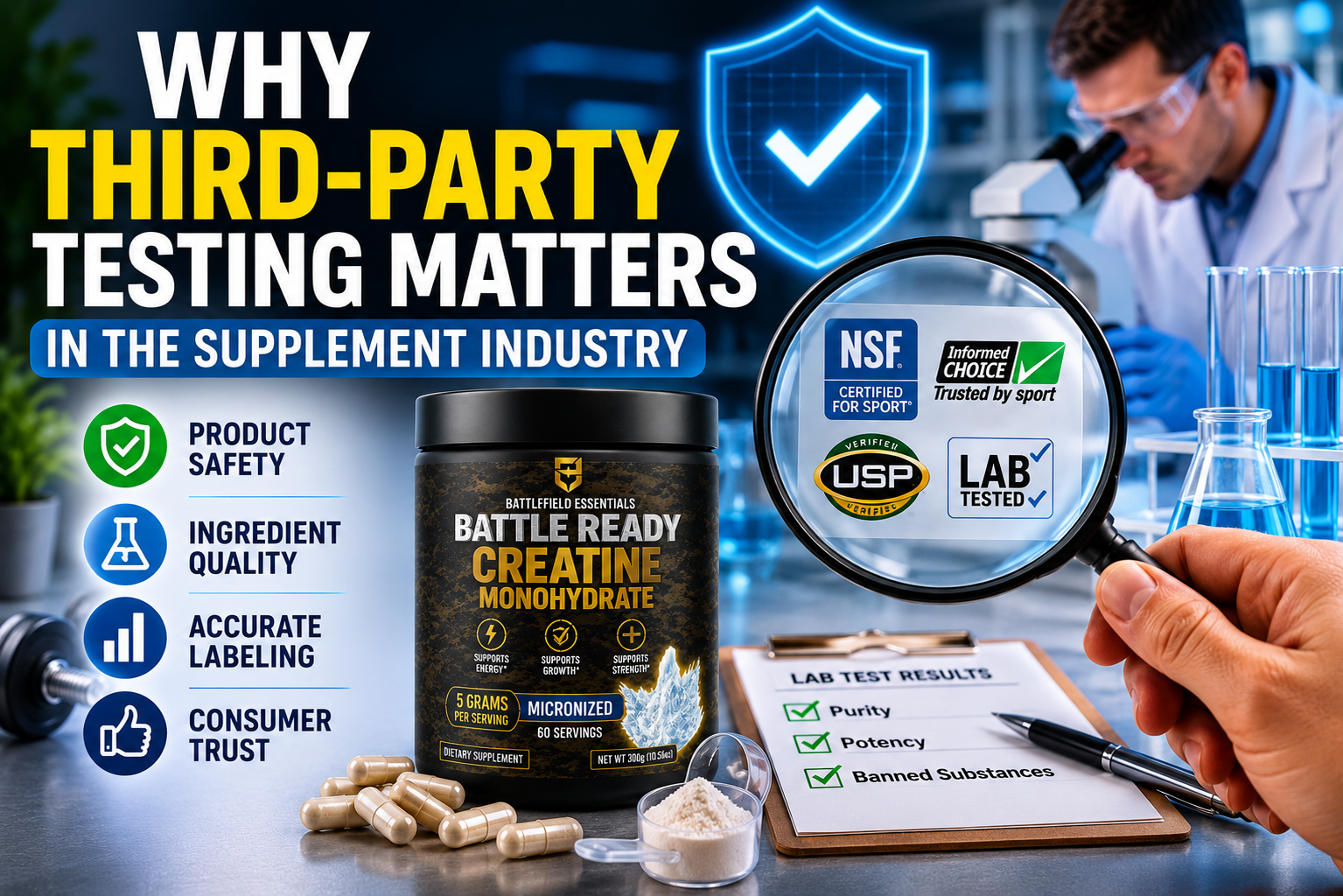
Third-party tested means an independent laboratory — one that doesn’t work for the brand and doesn’t profit from the sale — analyzes a finished product and verifies its contents. The lab checks two things: that the active ingredient is present at the dose claimed (potency), and that the product isn’t contaminated with heavy metals, microbes, or banned substances (purity).
The key word is independent. “Tested” on its own means nothing — a company can “test” a product in its own back room and call it whatever it wants. Third-party testing removes the conflict of interest. The lab has no reason to lie. Its name and accreditation are on the result, and its credibility is on the line every time it signs one.
For a category like creatine, this matters more than most people realize. Creatine monohydrate is cheap to manufacture and easy to cut with fillers or lower-grade material. The only way to know you’re getting 5 grams of actual creatine monohydrate — and not 3.5 grams plus filler — is an independent assay.
Why can’t I just trust the label?
Because the label is a promise, and promises are free. In the U.S., dietary supplements are not approved by the FDA before they go to market. The FDA can act after the fact if a product is found to be unsafe or misbranded, but no government agency is checking each tub before it ships to verify the label is accurate. That responsibility falls on the manufacturer — and on you.
That gap is exactly where bad actors operate. Underdosing, cheap raw materials, contamination from sloppy facilities, and “label decoration” (printing impressive numbers that the product doesn’t actually contain) are all common. None of it is visible to the naked eye. The powder looks the same whether it’s pure or padded.
“A label is a promise. A certificate of analysis is proof. We deal in proof.”
What is a proprietary blend — and what does it hide?
A proprietary blend is when a brand lists a group of ingredients under one total weight without telling you how much of each ingredient is in the mix. The label might say “Performance Matrix — 5,000mg” and then list eight ingredients underneath. You have no idea if that’s 4,900mg of cheap filler and a pinch of the good stuff, or an honest split.
Brands will tell you proprietary blends protect their “formula” from competitors. That’s the cover story. Here’s the reality:
- They hide underdosing. If an ingredient only works at 3,000mg and the brand uses 200mg, a blend lets them list it without admitting the dose is useless.
- They hide cheap fillers. Blends are often padded with low-cost ingredients to hit a big-looking total weight.
- They make third-party verification harder. You can’t check a dose you were never given.
A transparent label does the opposite. Every ingredient, every dose, in the open. If a formula is strong, there’s no reason to hide it. The only formulas that need a blend to survive are the ones that wouldn’t survive being seen.
This is why our entire line — including Battle Ready Creatine — uses no proprietary blends. Single ingredient. Full dose. Listed plainly. What’s on the label is what’s in the tub.
What is a Certificate of Analysis (COA)?
A Certificate of Analysis (COA) is the document a third-party lab produces after testing a product. It’s the receipt for the test. A real COA names the lab, identifies the specific batch (by lot number), states the methods used, and reports the results — purity, potency, heavy metals, and microbial safety.
A COA is the difference between a brand saying it tests and a brand proving it. Marketing copy that says “lab tested” with no document behind it is just more “trust me, bro.” Ask for the COA. If they can’t produce one tied to the batch you’re buying, treat the claim as fiction.
What should “third-party tested creatine” actually show you?
When you’re evaluating a third-party tested creatine — or any supplement — a legitimate result should report, at minimum:
- Assayed purity / potency — confirmation the product contains the creatine monohydrate it claims, at the dose claimed.
- Heavy metals screening — testing for lead, arsenic, cadmium, and mercury against a recognized standard (such as USP General Chapter <233>).
- Microbial safety — screening for harmful microbes against recognized methods (such as USP <2021>/<2022>).
- An accredited lab — ideally one accredited to ISO/IEC 17025, the international standard for testing laboratory competence.
- A traceable lot number — so the test matches the exact batch in your hand.
If a “tested” claim can’t be tied to those specifics, it’s decoration.
How Battlefield Essentials tests every batch
We don’t ask you to trust us. We publish the test.
Every batch of Battle Ready Creatine Monohydrate is analyzed by an independent, accredited laboratory, and the Certificate of Analysis is published directly on the product page — downloadable as a PDF, tied to the production lot. Here is what the most recent batch returned:
- Independent lab: Ethos Analytics
- Lab accreditation: ISO/IEC 17025 (#117798)
- Methods: ISO/IEC 17025:2017
- Assayed purity: 99.87%
- Heavy metals (USP <233>): Pass
- Microbials (USP <2021/2022>): Pass
- Lot tested: CM20251225A
That’s a single-ingredient, micronized creatine monohydrate at 99.87% assayed purity, screened for heavy metals and microbial contamination, verified by a lab we don’t own and don’t pay to say nice things. No proprietary blend. No filler. No flow agents. Five grams of creatine per serving, and the paperwork to prove it.
You can read the full panel before you spend a dollar. That’s the order of operations we think it should always be: verified, not vouched.
“You don’t get to fake discipline. You shouldn’t get to fake a supplement label either.”
How to verify any supplement before you buy it
You don’t need to be a chemist. Run this quick check on any brand — including ours:
- Find the COA. Is there an actual certificate, tied to a lot number? If it’s hidden or “available on request” with no follow-through, that’s your answer.
- Check who ran the test. Is the lab independent and accredited (ISO/IEC 17025)? A test by the brand’s own facility isn’t third-party.
- Read the label for blends. Any “proprietary blend” or “matrix” with a single combined weight = doses you can’t verify.
- Match the dose to the research. Creatine monohydrate is studied at 5g per day. If a “creatine” product buries a fraction of that in a blend, you’re paying for marketing.
- Confirm the basics. Single, clearly listed ingredients beat long lists of fillers and flow agents every time.
If a brand passes all five, buy with confidence. If it fails even one, keep your money.
The bottom line
The supplement industry runs on the assumption that you won’t ask hard questions. Third-party testing is how you ask them — and a published Certificate of Analysis is how a brand answers. Everything else is a story.
We built Battlefield Essentials because we were tired of the story. Clean inputs, full doses, independent testing, and the paperwork on the table. You do the work. This is fuel you can verify.
See the Battle Ready Creatine test results →
Frequently Asked Questions
Is Battle Ready Creatine third-party tested?
Yes. Every batch is tested by an independent, ISO/IEC 17025–accredited lab for purity, potency, heavy metals, and microbial safety. The Certificate of Analysis is published on the product page and tied to the production lot.
What is third-party testing?
It’s analysis of a finished product by an independent laboratory that doesn’t work for the brand — verifying the product contains what the label claims and is free of contaminants like heavy metals and microbes.
Why are proprietary blends a problem?
They list a group of ingredients under one combined weight without disclosing individual doses, which can hide underdosing and cheap fillers. Battlefield Essentials uses no proprietary blends — every ingredient and dose is listed.
How pure is Battle Ready Creatine?
The most recent batch (lot CM20251225A) returned 99.87% assayed purity, with heavy metals (USP <233>) and microbials (USP <2021/2022>) both passing.
Where can I see the Certificate of Analysis?
On the Battle Ready Creatine product page — it’s a downloadable PDF tied to the tested lot.
About the Author
Battlefield Essentials was founded by Bobby Harris, a U.S. Navy FMF Corpsman and OEF (Afghanistan) veteran. After service, he spent over a decade working twelve-hour shifts in metal stamping plants before building the supplement brand he wished existed — one that shows its work. Battlefield Essentials runs on the same standard the job demanded: no fillers, no fluff, just proof.
These statements have not been evaluated by the Food and Drug Administration. This product is not intended to diagnose, treat, cure, or prevent any disease. Always consult a qualified healthcare professional before beginning any dietary supplement program.